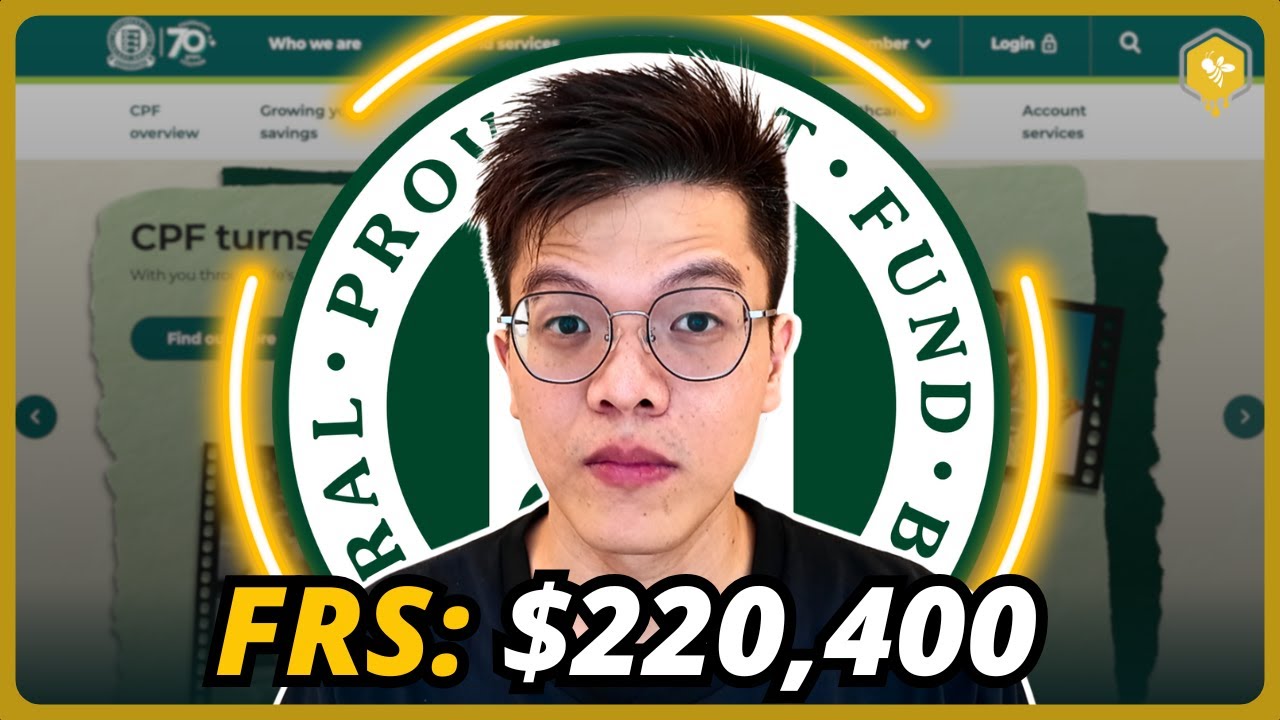
Four years ago, I topped up my CPF Special Account to the Full Retirement Sum at age 30. Some of my friends thought I was locking money away for no good reason. I was not sure they were wrong.
Every year since, I come back and share what the numbers actually look like. The real balances, the real interest, the honest reflection. This is year five.
Where my CPF stands today
When I first hit the Full Retirement Sum in 2022, the FRS was $192,000. I have not made a single Retirement Sum Top-Up since January of that year. Once you hit the FRS, the RSTU window closes permanently. You simply cannot top up above it. So everything that has happened since is purely from mandatory employment contributions and the 4% annual interest compounding quietly in the background.
My Special Account is now above $250,000. The current FRS is $220,400. The gap keeps widening, every year, without me doing anything.
For 2026 I am forecasting around $14,000 in total CPF interest across my three accounts. About $10,000 from SA and $4,000 combined from OA and MA. I will share the actual figures once January closes.
The 0.5% that changes everything
The FRS increases by roughly 3.5% per year. The Special Account earns 4% per year. That 0.5% difference means that once you hit FRS, you will always clear the following year's FRS on interest alone. I have watched this hold true every single year since 2022.
If you are on the path to FRS right now, that is what is waiting. A number that grows faster than the target it is chasing.
The January Medisave window
My MA was at $75,500 last year, sitting at the Basic Healthcare Sum. The new BHS for 2026 is $79,000. When the 4% interest was credited to my MA, it flowed straight out to my OA, since I was already at BHS and my SA is already at FRS. My MA dropped back to $75,500.
That $3,500 gap is a VCMA top-up window. For those who want to claim that tax relief, the clock starts on 1 January and closes the moment your first mandatory contribution of the year hits your MA. For salaried employees that window can be just a few days. Miss it and you wait another year.
I am not doing VCMA this year. I am prioritising SRS for tax relief since those funds can still be put to work in investments. My situation as a business owner gives me more flexibility on timing. If you are on a fixed salary, think about this in the first week of January.
Supercharging and the new salary ceiling
Supercharging only works when both your MA is at BHS and your SA is at FRS. When both are full, mandatory MA contributions overflow to SA, and if SA is already at FRS, they flow to OA instead. That is where the supercharged OA effect comes from.
The CPF monthly salary ceiling has gone up from $7,400 to $8,000 this year. At a 30% supercharged OA rate, that is $2,400 per month going into your OA. I use part of mine for my HDB mortgage and invest the rest through CPFIS via POEMS. No sales charge, no platform fees. If you want to do the same, you can sign up via my link below.
📈 Invest your CPF OA through POEMS. No sales charge, no platform fees on unit trusts. This is the platform I personally use for CPFIS investing.
Sign up for POEMS →Turning 35 this year
I am turning 35 in a few months. The CPF contribution allocation percentages shift at this age and it is worth knowing before it happens.
Do I regret it?
Two questions come up every year. I want to answer them properly.
Did I top up too early and lose tax relief in my higher income years?
Yes. My RSTU window is permanently closed. My income has grown since 2022 and the $8,000 annual tax relief from RSTU would carry more weight today than when I first used it. That is real and I cannot undo it. What I still have is the VCMA window each January when the BHS cap rises, deductions from insurance premiums like MediShield Life and CareShield Life that create further VCMA opportunities, and SRS up to $15,300 which is my main tax relief tool right now.
Should I have put that money into equities instead?
The market ran hard after 2022. If I had invested that same capital into index funds, the returns would have been higher. That is the honest answer.
At that point in my life though, six or seven years ago, what I needed was not the highest return. I needed to feel that retirement was settled so I could stop thinking about it. Hitting FRS gave me that. Once it was done, my mind was free to focus on other things. I quit my corporate job. I built a business. I made bold bets I would never have made if I was still anxious about the long game. The business returns have far outpaced whatever the market would have given me.
So yes, the equities path would have generated more on paper. But I am genuinely happy with the trade-off I made. Some decisions are worth more than the spreadsheet shows.
Do not rush to hit FRS because of my story. CPF rules have changed significantly since I did it. What worked for my situation may not fit yours at all. The more useful question is not whether to hit FRS, but what you actually need to feel secure enough to take the risks that matter to you.
I will do this update again next year. Full CPF supercharging breakdown by age is in my CPF strategy 2026 post if you want to go deeper.